The Right Way to Structure a Company with Multiple Founders
I’ve learned a lot over my 14 years as an entrepreneur, both from my own experiences and from friends.
While I believe in trusting people until they prove they can’t be trusted, it’s always best to protect yourself in business and ensure everyone’s goals are aligned. Misaligned incentives and structures can tear apart a business a million different ways. The best way to prevent collapse is with a strong and firm foundation.
Unless you went to business school, you probably don’t know this. And even if you did, you’d be surprised at how few entrepreneurs actually implement it.
If you’re co-founding a company with multiple founders, whether or not you’re going to raise money, here’s what I believe is the best option:
Set up - Delaware LLC or C-Corp (If you’re going to raise money, just do C-Corp)
Even if you go with an LLC, you should set it up with an ownership structure similar to a C-Corp. What do I mean by that? Ownership Tables with Vesting Schedules.
I truly wish I had known this sooner. No one told me, so I’m telling you.
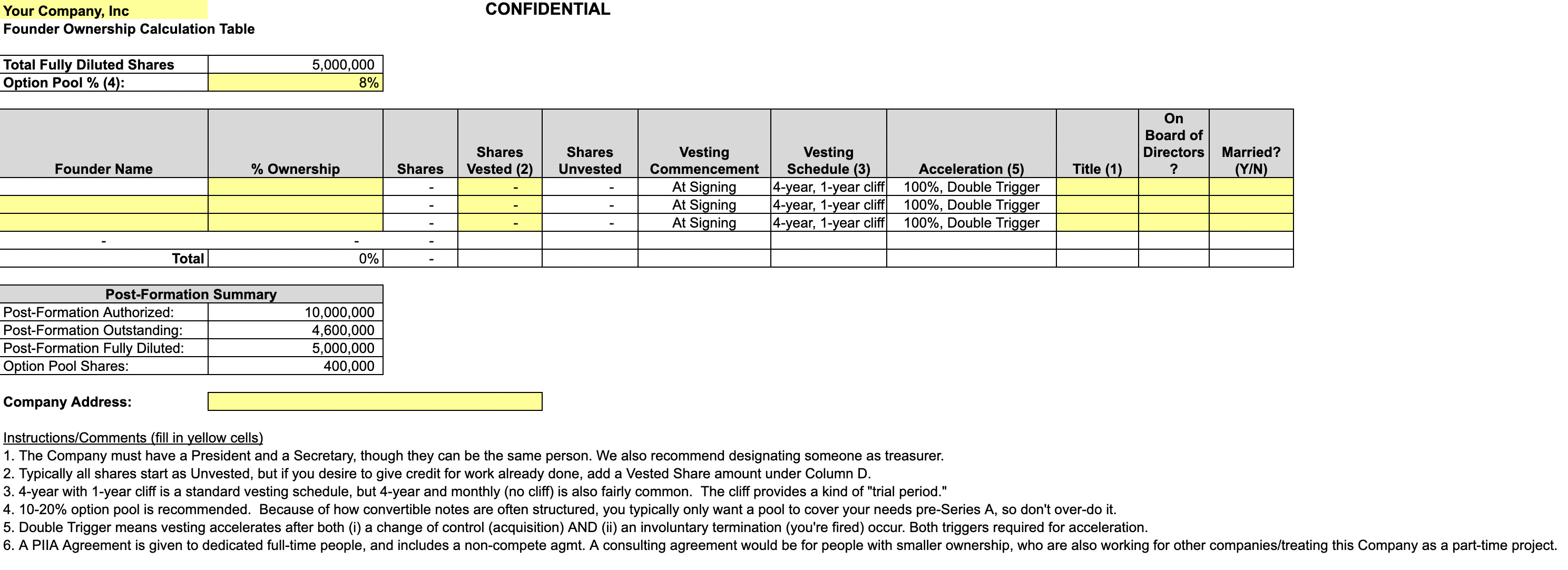
Want to see the full table in Google? Click here & Copy
One thing I didn’t know after 14 years of entrepreneurship was the steps and paperwork needed to create a C-Corp. The agreements are more ironclad and allow for much more flexibility in the early stages (as well as being required for most external funding or use of a SAFE).
These documents are required for a C-Corp, but you can have a lawyer amend your LLC agreement to include a similar concept.
The most significant benefit of this type of agreement is vesting.
To explain why this is so important, let me tell you a story about a friend. We’ll call her Jessica. After taking an entrepreneurship class in college, Jessica started a company with a few of her classmates based on their class project.
The business had decent early traction and solved a real need, but required expensive development work to bring to market. The classmates quickly set up an LLC and split ownership evenly.
However, once an LLC is set up, without an ironclad operating agreement, it’s nearly impossible to kick anyone out, which is precisely what happened to Jessica and one of her partners.
Shortly after realizing how much money it would require to develop a fully functioning version of their product, one founder left and wanted to be bought out. Although she hadn’t contributed much more than homework, she demanded tens of thousands of dollars or to remain an owner despite not contributing. (More on this below)
There are ways of legally removing or diluting people like this when you allow instant vesting, but that only works if you have money and they don’t. For this example, we’ll assume you don’t have excess personal capital.
Eventually, they sorted things out, reformed their LLC, and got things back on track, but only after wasting thousands of dollars and months of valuable time.
With a proper vesting agreement, that founder would have left without any vested shares.
The better option?
A proper founder vesting schedule and capital calls. All initial founders should be required to buy into the business, even if only to split the legal fees of formation.
From there, a proper 4-year, 1-year cliff vesting schedule ensures alignment through the “trial period” of starting a business. No shares are granted upfront, and 25% of the founders’ shares will vest after 1 year, ensuring that no one who walks away within 12 months is a dead weight to your business. The remaining 75% vests monthly over the next 3 years.
In a business that’s evenly split 4 ways, here’s what that means:
End of Year 1 - 25% vested on 25% ownership = 6.25%.
That means that if they walk after a year, you’ll only be out 6.25% of your company instead of 25%. The rest of those shares can be split among the 3 remaining founders or added to an employee option pool to help attract great talent to fill the shoes of the founder who left.
It’s also important to keep in mind that this is considered table stakes for VC investments. No VC is going to invest into a company that’s 3 months old where all 4 founders are fully vested, knowing that if 1 or 2 walk, their investment will disappear into thin air.
Caveat: If founders are putting in a meaningful amount of money to get things off the ground, a small portion of their shares should be granted immediately. If it’s under $5,000, that’s just payment to play.
No Hostages
You should also assign all IP to the business immediately: domain names, trademarks, formulas, design files, etc. Those instantly become the company’s property and not a bargaining chip to hold founders hostage.
Other Benefits
If you’re a solo founder who’s going to bootstrap, keep it as an LLC. If you’re running a business with multiple founders, LLCs offer a lucrative way to reduce taxes on income. But those incentives can quickly turn from “Let’s write things off & save money” to “This business bank account is my personal piggy bank.”
With a C-Corp and proper governance structure, you’ll need to have board approval for any “compensation”, including things like a $600 bounce for your co-founder’s kid’s birthday party. (Yes, this actually happened with someone I know.) Assuming you didn’t give one founder 51% voting control in your company, this can be prevented.
Proper use of company funds is tightly regulated, which is why so many large companies have “overzealous” accountants watching expense accounts.
How to structure control
If someone claims they need 51% of the voting shares to run the company, that should be a huge red flag 99% of the time. (It’s obviously worked well for Meta with Mark Zuckerberg in charge, but clearly didn’t work out well for Eduardo Saverin.)
Exceptions to this would be: One of Four founders is a veteran bringing experience & far more money to the table. I’m talking $500k investment compared to $50,000. If someone is investing $10,000 and you’re investing $2,500, please don’t give up control.
In a business with partners, it’s important that everyone has a voice and can exercise their opinion. In my opinion, in a business of 3+, the person with the largest share should control no more than 50% of the shares or voting rights.
When someone owns 51%, it’s far easier to spend frivolously, grant large pay packages to themselves, which leads to another important topic:
Salaries of Founders
In most cases, founders shouldn’t determine their own salary, it should be set by their founding partners as part of a group discussion. In most cases, operating agreements should lock founders into a set salary or compensation package each year. The only time this would change is with a set milestone based stretch goal you set at the start of the year, or salary reductions at any time if needed, such as running out of money or a founder leaving.
A caveat here is this: If one person is handling sales, ensure a proper capped commission rate on top of a lower salary. That person should be incentivized to win, but most winnings should be shared or founders will get jealous. If they’re capturing value, motivation can come from commissions to an extent, but founders value & motivation should also come from equity and dividends.
Founders should almost always have a hard capped bonus of a maximum of 30% of their yearly salaries. This should be set in stone without any possibility for change outside of unanimous agreement. The rest should be paid out to owners via dividends. This prevents working owners from soaking all profits from non-working owners.
Operating Agreements
If you make it past 4 years and are fully vested, operating agreements should be reviewed, revised (if needed), and agree upon every 2 years to ensure stability.
Maybe younger founders have gained experience and the original agreement no longer aligns the interests of the business properly.
Maybe one founder left after 4 years and now it’s time to revise.
Maybe one founder is on vacation for 4 months a year and taking full salary while the others are barely taking off 2 weeks a year.
No matter what it is, these are in place to make things operate smoothly and with minimal conflict.
Firing a Founder
If someone is underperforming in their role as a founder and has not vested their ownership, firing that founder would lead to all of that founder’s shares being returned to the company or destroyed. That way, you can make a clean break without having someone on your cap table who’s no longer contributing or could be a reputational risk.
In situations where it’s just two founders, there really isn’t a great solution. As long as IP is assigned to the company, one founder can’t walk and compete.
If as a founder, you made a larger capital contribution, ensure that a portion of your shares are already vested at setup. This could also be done with anyone making important IP contributions in the $10k+ range. Think:
-
Valuable domains
-
Trademarks or patents
-
Software
In cases where a founder is contributing massive upfront value, they should have instantly vested shares or should have an agreement where IP only transfers after their first tranche of shares have vested.
Exit Plans
If founders are vested in a bootstrapped business and one founder leaves, there are a few options:
-
If the founder wants a buyout, there should be terms set to determine a fair valuation for all parties.
-
If the other founders want to buy them out, they can make an offer.
-
You can pay them dividends while they keep their stock until it sells.
If they stayed for any period to allow vesting, this is what is fair to that founder.
Keep in mind that you’ll want agreements in place that allow you to approve or reject any sale of stock to outsiders by owners.
Bonus - Capital Calls
Be aware of capital calls. It’s very rare and unlikely unless you have the scummiest partners, but it can happen. If a single founder who’s in control is wealthy, or multiple founders wealthier than you, they can issue a capital call at a lowered valuation.
What does that mean?
Say you’re a 1/4th owner of a business. You have 3 co-founders who have more available cash than you. It would be possible for them to vote to issue a capital call at a lowered valuation. Say you own 25%, they could issue a capital call or stock issuance of $3m at a $4m post-money valuation.
That means that the business was worth $1m before they purchased those shares, so you owned 25% of a $1m business, or $250k. After they buy $3m of new shares (not increasing your value, just issuing new shares), it’s now worth $4m, but you still only own $250k worth of stock. Those partners just diluted you from 25% down to 6.25%.
I’ve never dealt with this and I don’t know of anyone personally who has. If you’re worried it could happen, you can protect yourself with anti-dilution provisions and consent requirements in your operating agreement.
Wrap Up
In business, it’s important to align with founders who share similar goals and ambitions. But, over time, people change, visions change, and it’s fair for founders to want flexibility without giving up the ownership they earned through years of contribution.
As someone who was burnt out on 13 years of working on the same business and walked away with nothing, my advice above comes from my own life experience with founders I grew up with and fully trusted.
9 months post exit, my biggest regret was that one founder owned 51% of the business. My second biggest regret was that our operating agreement was 7 years old and gave no flexibiltiy to any founders who no longer wanted work full time on the business. If you walked, you got nothing.
Hindsight is 20/20. Looking back, it’s very easy to see all of the massive flaws I had overlooked in the moment. Any lawyer who looked at the old agreement would have told me it was terrible. But, because I had no real say and no savings seven years ago, there was no way to negotiate a better option.
With that said, the journey I went on has led me to where I am today. While I’m not happy with how the first part of the journey ended, I wouldn’t be here without it.